Table of contents
ToggleAir traffic across Europe is rising fast. Consequently, managing congested skies has become a major challenge. Current air traffic management (ATM) systems face mounting pressure. Specifically, the interaction between civil and military aviation is complex and often lacks interoperability.
Traditional systems struggle to keep pace. As a result, the industry faces potential delays and safety concerns. However, Artificial Intelligence (AI) offers a promising solution. Technologies like machine learning are transforming the industry.
ATM-EXCITE is at the forefront of this shift. We utilize AI to enhance communication, navigation, and surveillance. By leveraging real-time data, we help controllers make quicker decisions. Thus, we ensure smoother and safer airspace operations.
Revolutionizing Air Traffic Management
AI is becoming an essential tool for ATM. With increasing traffic volume, traditional controls are under stress. Therefore, controllers are integrating AI to optimize routing and reduce delays.
Furthermore, AI helps controllers make accurate decisions. This minimizes human error while enhancing efficiency. One key contribution is processing vast amounts of data in real time. For instance, systems can adjust routes dynamically based on weather or traffic patterns.
Moreover, machine learning algorithms learn from past scenarios. This allows the system to predict potential delays. In addition, AI can manage routine tasks. Consequently, controllers can focus on critical decisions.
How is AI used in Air Traffic Control?
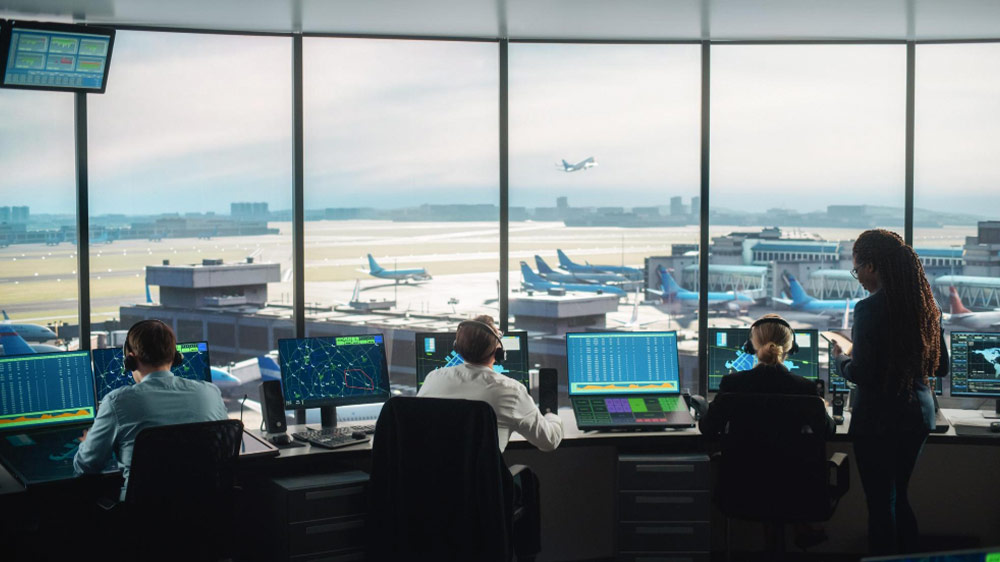
AI is transforming control by automating flight management. First, it automates flight routing. Systems optimize paths in real time to avoid congestion. By analyzing weather and flow data, AI predicts bottlenecks. Then, it suggests alternative routes before issues arise.
Second, AI improves decision-making. It analyzes the movements of multiple aircraft at once. This gives controllers a clear picture of the airspace. Whether adjusting altitudes or re-routing, AI assists with great accuracy.
Finally, AI provides continuous updates on flight status. This support reduces the workload on controllers. As a result, traffic moves smoothly, even during peak times.
AI in Traffic Management
AI plays a crucial role in coordinating civil and military aviation. Currently, incompatible systems hinder this interoperability. However, AI is addressing this issue. It provides a unified platform to integrate diverse data.
By using machine learning, AI manages traffic in shared airspace. This reduces conflict risks and enhances safety. Additionally, AI excels in real-time management. It processes vast datasets, including flight paths and traffic density. Thus, controllers gain actionable insights to minimize delays.
Furthermore, AI enables dynamic decision-making. It adjusts paths instantly based on sudden changes. This ensures effective responses to evolving conditions.
Artificial Intelligence in Airport Management
AI is also streamlining airport operations. One key application is predictive analytics. Algorithms forecast passenger traffic patterns using historical data. Consequently, airports can optimize staffing and security.
In addition, AI enhances safety. For example, facial recognition systems improve screening processes. This reduces wait times while maintaining high security. Moreover, AI helps identify suspicious behaviors automatically.
Regarding scheduling, AI processes flight and gate data. It predicts delays and suggests alternatives. Also, AI-driven systems manage congestion by adjusting check-in lines. This results in a smoother experience for passengers.
AI in the Aviation Industry
The impact of AI goes beyond traffic control. In fact, it touches everything from aircraft design to maintenance. For instance, engineers use AI to analyze simulations and optimize fuel efficiency.
In maintenance, AI detects potential issues early. Sensors on aircraft predict wear and tear. Therefore, airlines can schedule repairs only when necessary. This avoids costly disruptions.
Regarding fuel management, AI analyzes weather and traffic to recommend efficient routes. Meanwhile, customer service benefits from chatbots and virtual assistants.
In summary, the benefits are significant. Airlines reduce costs, and airports manage crowds better. Ultimately, AI boosts customer satisfaction and loyalty.
Overcoming Challenges with ATM-EXCITE
Europe’s current systems are under pressure. Specifically, the lack of coordination between civil and military aviation is a bottleneck. This leads to inefficiencies.
ATM-EXCITE aims to break these barriers. We integrate state-of-the-art solutions to enhance capabilities. By doing so, we pave the way for a safer air traffic management system across Europe.